


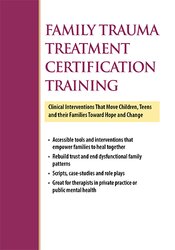
2-Day Family Trauma Treatment Certification Training: Clinical Interventions That Move Children, Teens and Their Families Toward Hope and Change
Clinical Interventions That Move Children, Teens and Their Families Toward Hope and Change
- Speaker:
- Nathan Croy, LCMFT, CFTP
- Duration:
- 12 Hours 33 Minutes
- Language:
- Presented in EN, subtitles in EN and FR, handouts in EN and FR
- Format:
- Audio and Video
- Copyright:
-
Jan 20, 2022
- Product Code:
- POS058610
- Media Type:
- Digital Seminar

Description
When children and adolescents are exposed to trauma it affects everyone in the family.
And without addressing the entire family system in treatment, the progress you make in sessions can quickly evaporate when kids and teens leave your office and return to the dysfunctional and negative patterns of their home life.
Now with this new comprehensive 2-day certification training you can go beyond individual therapy and get an accessible roadmap for integrating the entire family into trauma treatment for results that last.
Full of ready to use tools, specific clinical interventions and expert practice tips, you’ll finish this training feeling ready and capable to empower families to work together and heal!
When you register you’ll get everything you need to:
- Skillfully get parents and caregivers on board with being part of treatment
- Establish the physical and emotional safety necessary for effective therapy
- Make and maintain progress by teaching caregivers to respond to trauma driven behaviors
- Overcome the defenses, deflections and frustrations that can keep families from healing growth
- Help families improve communication, set healthy boundaries and rebuild trust
- And much more!
Best of all, you can add a valuable certification to your resume and become a Certified Family Trauma Professional (CFTP) through Evergreen Certifications upon completion of this training at no additional cost to you!
Don’t miss this chance to bring greater healing and lasting positive change to your young clients without the frustrations of lost progress when they head home.
Purchase today!
CERTIFICATION MADE SIMPLE!
- No hidden fees – PESI pays for your application fee (a $149.99 USD value)*!
- Simply complete this seminar and the post-event evaluation included in this training, and your application to be a Certified Family Trauma Professional through Evergreen Certifications is complete.*
Attendees will receive documentation of CFTP designation from Evergreen Certifications 4 to 6 weeks following the program.
*Professional standards apply. Visit ca.evgcert.com/cftp for professional requirements.
Credit
Speaker

Nathan Croy, LCMFT, CFTP Related seminars and products
ExFT, LLC
Nathan D. Croy, LCMFT, CFTP, is a clinically licensed marriage and family therapist with extensive experience working with families, teenagers and children impacted by trauma, depression, anxiety, addiction and abuse.
Nathan has been designated a Clinical Fellow by the American Association for Marriage and Family Therapy (AAMFT) and is a Certified Family Trauma Professional (CFTP) through Evergreen Certifications. He is also trained in Trauma Systems Therapy, Parent Management Training and EMDR.
In addition to private practice, Nathan has extensive experience working in outpatient and inpatient settings including in foster care systems, a psychiatric hospital and as a therapist at The University of Kansas Hospital. He earned his master’s in marriage and family therapy from Bethel Seminary.
Speaker Disclosures:
Financial: Nathan Croy has an employment relationship with Existential Family Therapy, LLC. He receives a speaking honorarium and recording royalties from PESI, Inc. He has no relevant financial relationships with ineligible organizations.
Non-financial: Nathan Croy has no relevant non-financial relationships.
Additional Info
Program Information
Access for Self-Study (Non-Interactive)Access never expires for this product.
For a more detailed outline that includes times or durations of time, if needed, please contact cepesi@pesi.com
Questions?
Visit our FAQ page at https://www.pesicanada.ca/faq or contact us at https://www.pesicanada.ca/contact-us.
Objectives
- Investigate Bowen’s conceptualization of chronic stress and its effects on the individual and family unit.
- Analyze the clinical implications of caregivers’ responses to trauma driven behaviors children and adolescents.
- Investigate how common systemic models of family-based treatment can be utilized in a clinical setting.
- Assess for domestic violence and other risks in at risk families.
- Use family sculpting techniques in session to reveal dysfunctional family dynamics that can inform treatment approach.
- Develop a trauma treatment plan from a family and relational systems perspective.
- Apply safety planning to stabilize families for treatment.
- Employ strategies with caregivers, kids and adolescents to improve engagement in treatment plans.
- Utilize psychoeducation techniques to teach caregivers to depersonalize trauma driven behaviors.
- Employ in-session psychoeducation approaches to help clients become aware of problematic behaviors.
- Use evidence-based strategies in trauma treatment to help families enhance self-regulation.
- Utilize clinical techniques to help families set and reinforce healthy boundaries.
- Employ specific therapeutic tools in sessions to facilitate forgiveness of self and others in the family system.
Outline
How Trauma is Created and Maintained in Families- Neurological substrates and sources of trauma
- Trauma as a disruption of trust
- Personal innate resiliency
- Impacts on family culture
- Responses of the people around the person experiencing the trauma
- Maintenance of trauma effects (re-traumatization, dismissive of actual trauma, ignorance)
How Treating Families Instead of Individuals Improves Outcomes
- Families as the source of healing for trauma
- Create secure connections and increase resiliency
- Build trust as it relates to anxiety, fear, threat
- Bowenian Family Therapy, Emotionally Focused Family Therapy and other systemic models
- Research, risks and treatment limitations
A Clinician’s Guide to Establishing Physical and Emotional Safety
- Risk Assessments
- Systemic Safety Planning
- How to customize the safety plan
- Managing physiological responses
- Integrating with treatment
- When it’s a bad idea to include the whole family
- Assessing for DV and other risks
- Use family sculpting to reveal family dynamics
- Working individually in order to work systemically
- Games and activities to:
- Assess a child’s self-esteem and world view
- Increase open communication
- Identify themes to be explored in future sessions
Coping Skills to Modulate Emotions and Trauma Responses
- Implementation
- How to notice warning signs early
- Using coping skills for calm
- Identifying primary emotions
Teach Caregivers to Depersonalize and Better Respond to Trauma Driven Behaviors
- Identifying reactions
- Scripts
- Case studies
- Role-plays to ensure proper implementation
Effective Strategies and Interventions to Overcome Resistance and Help Families Grow
- Preparing families for resistance to growth
- Tips for reframing the problem as the solution
- Effective ways to deal with deflection and defenses
- The difference between deflection, projection, and transference
- Ego defense mechanisms or personality disorder?
- FAIR intervention to mitigate frustration
- Three phases of family growth (Protect, Prepare, Participate)
How to Improve Communication, Set Healthy Boundaries and Rebuild Trust
- Practical tips for educating families on boundaries
- The House Metaphor for understanding boundaries
- Reinforcing boundaries after setting them
- Boundaries vs rules – the benefits of agreements vs. control
- Rebuilding trust – what works and what doesn’t
- Trust Equation – an online assessment
Exercises to Facilitate Forgiveness, Build Empathy and Move Families Forward
- Addressing shame in family systems
- Overcome the impact of survivors’ guilt on families
- How family members can stop “shoulding” themselves
- The Forgiveness Triangle (Empathy, Grief, Meaning)
- Exercises to facilitate the forgiveness of self
Target Audience
- Counselors
- Addiction Counselors
- Marriage & Family Therapists
- Social Workers
- Psychologists
- Psychiatrists
- Physicians
- Nurses
- Other Professionals Who Work within the Mental Health Fields
Reviews
Satisfaction Guarantee
Your satisfaction is our goal and our guarantee. Concerns should be addressed to info@pesicanada.com.
Please wait ...