


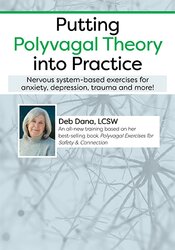
Putting Polyvagal Theory into Practice: Nervous-system based Exercises for Anxiety, Depression, Trauma and more
- Speaker:
- Deborah Dana, LCSW
- Duration:
- 6 Hours 21 Minutes
- Language:
- Presented in EN, subtitles in EN and FR, handouts in EN and FR
- Format:
- Audio and Video
- Copyright:
-
Sep 29, 2022
- Product Code:
- POS058115
- Media Type:
- Digital Seminar

Description
At the heart of our client’s symptoms – from anxiety and depression to traumatic stress and more – is a dysregulated nervous system.
Polyvagal theory finally presents a clear roadmap of our nervous system that can guide both therapists and clients to the source of their most troubling symptoms.
And Polyvagal-informed treatments provide interventions that not only empower clients to understand how their nervous system shapes their experiences, but also gives them powerful methods to re-shape those experiences in therapy.
Watch Deb Dana, the world’s foremost translator of Polyvagal theory into clinical practice, in this all-new training based on her best-selling book Polyvagal Exercises for Safety & Connection as she shows you, step-by-step to:
- Track a client’s experience through their autonomic nervous system and uncover the specific places that keep them stuck
- Interrupt and re-shape habitual autonomic patterns that cause their emotional suffering, maladaptive thoughts, and un-helpful or impulsive behaviors
- Learn how to introduce Polyvagal practices in session
- See and experience real demonstrations
With Deb Dana’s practical guidance, it’s now possible to get beneath symptoms and show clients how to safely listen to the “story” of their autonomic nervous system and to re-shape their experience toward safety and connection.
Understanding the human nervous system through a Polyvagal lens has been a game-changer for therapists across modalities. There is no better way to learn it than through experiencing it yourself in this highly practical, intervention-rich training.
Purchase today!
Credit
Speaker

Deborah Dana, LCSW Related seminars and products
Deb Dana, LCSW, is a clinician and consultant specializing in using the lens of Polyvagal Theory to understand and resolve the impact of trauma and create ways of working that honor the role of the autonomic nervous system. She developed the Rhythm of Regulation Clinical Training Series and lectures internationally on ways Polyvagal Theory informs clinical work. She is a founding member of the Polyvagal Institute, clinical advisor at Khiron Clinics, and an advisor to Unyte.
Deb is the author of The Polyvagal Theory in Therapy: Engaging the Rhythm of Regulation (Norton, 2018), Polyvagal Exercises for Safety and Connection: 50 Client Centered Practices (Norton, 2020), Befriending Your Nervous System (Sounds True, 2020), Anchored: How to Befriend Your Nervous System Using Polyvagal Theory (forthcoming from Sounds True), co-editor of Clinical Applications of the Polyvagal Theory: The Emergence of Polyvagal-Informed Therapies (Norton, 2018), and creator of the Polyvagal Flip Chart (Norton, 2020).
To learn more, visit rhythmofregulation.com or polyvagalinstitute.org.
Speaker Disclosures:
Financial: Deborah Dana maintains a private practice and is an advisor with Unyte/iLS. She receives compensation as a International and Keynote speaker and royalties as a published author. She receives a speaking honorarium and recording royalties from Psychotherapy Networker and PESI, Inc. All relevant financial relationships with ineligible organizations have been mitigated.
Non-financial: Deborah Dana has no relevant non-financial relationships.
Additional Info
Program Information
Questions?Visit our FAQ page at https://www.pesicanada.com/faq or contact us at https://www.pesicanada.com/contact-us
Access for Self-Study Program (Non-Interactive)
You will have access to this product for 12 months from the date of purchase.
Objectives
- Propose language to successfully introduce nervous system-based interventions with clients.
- Evaluate the five phases of the BASIC approach to polyvagal-informed treatments.
- Apply one exercise from each phase of the BASIC approach.
- Assess timing of moving between phases with clients.
- Construct practices between sessions to successfully shape new autonomic patterns.
- Utilize personal progress trackers to assess client progress.
Outline
How Polyvagal Theory Provides a Foundation for Lasting Therapeutic Change- The BASIC approach to Polyvagalinformed treatment
- Trauma healing from a Polyvagal theory perspective
- Learning to stretch, but not stress, a client’s nervous system
- Co-regulation: An imperative in psychotherapy
- The three-part hierarchy of the autonomic response
- Neuroception: our internal surveillance system
- How early experiences and trauma shape our nervous system
- Exploring Hierarchies
- Identifying landmark moments in our nervous system
- Recognizing ventral vagal “anchors”
- Utilizing the social engagement scale
- Creating a neuroception notebook
- Building attention through naming autonomic states
- Daily tracking practices
- Attending over time
- Savoring practices
- Moving out of dorsal vagal collapse and sympathetic activation
- Neural exercises for creating resilience and psychological flexibility
- The power of utilizing autonomic imagery
- Establishing new autonomic patterns and behaviors in life
- Moving from intention to action
- Learning to engage the vagal brake
- Exercising and strengthening the social engagement system
- Learning to feel safety in connection
- The reciprocity equation
- Creating a personal connection plan
- Tracking the flow of a Polyvagalguided session
- Polyvagal-guided assessment and treatment planning
Target Audience
- Counselors
- Social Workers
- Psychologists
- Case Managers
- Addiction Counselors
- Physicians
- Therapists
- Marriage & Family Therapists
- Nurses
- Other Mental Health Professionals
Reviews
Satisfaction Guarantee
Your satisfaction is our goal and our guarantee. Concerns should be addressed to info@pesicanada.com.
Please wait ...